
Many people believe that it is the wind that destroys houses during a storm, but in reality, it is the debris carried by the wind that causes damage to windows and other parts of the house. For example, a piece of wood, a chair from the garden, or a part of a fence can break a window due to the force of the wind and not the window itself breaking. When the window is broken, the wind and rain can then enter the house and cause even more damage.
Why one broken window can take the roof with it
Here’s what no one’s telling you at the hardware store. A sealed house resists wind because the pressure stays balanced, more or less what’s pushing on the outside equaled by what’s within. The minute a window or door collapses, wind rushes into that gap and the internal pressure spikes. The pressure has nowhere to go but up, against the underside of the roof structure. Homes with an otherwise solid frame can lose their entire roof once a single opening yields. Engineers dub this internal pressurization. It’s why FEMA and building-science groups are so adamant that every opening in a house – not just the roof – becomes a structural liability in high winds.
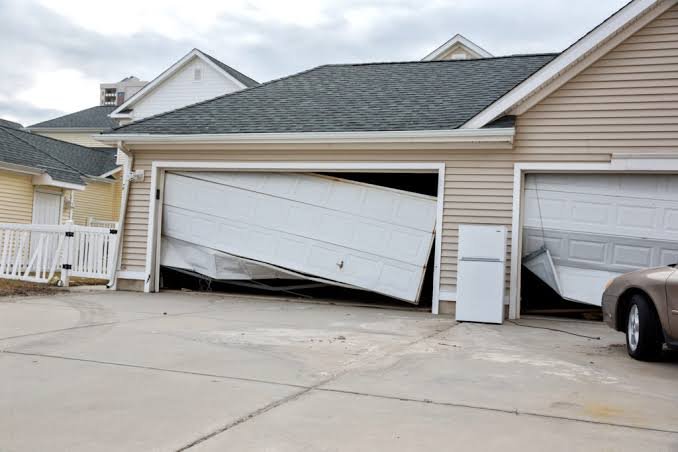
The garage door is typically the largest single opening in a home and one of the least engineered. A standard door built for convenience, not wind load, can buckle in under pressure that a properly rated window would shrug off. Once the door fails, the garage becomes a pressure chamber connected to the rest of the house over the shared internal walls and ceiling. The garage goes and then everything else goes in the cascade effect that turns up storm after storm in damage assessments.
What “storm-rated” actually means
Marketing hype easily exaggerates the level of storm protection a product offers. The terms “Hurricane-resistant” and “storm-proof” are slapped on products without any testing or standards to verify those claims. But wind-resistant construction and impact resistance are two separate things that need to be proven – and they’re not the same.
Wind load is the pressure a product can withstand over time, measured in pounds per square foot (PSF) in the US or kilopascals in Australia. Debris impact is completely different; the industry standard ASTM E1996, for instance, involves firing a 2×4 timber stud at the product at a set speed to simulate being hit by a piece of wood thrown in a storm. A product can be rated for wind pressure and still shatter at the first impact if it hasn’t undergone missile testing as well.
In Australia, garage doors and any larger openings in cyclone-prone zones are covered by AS/NZS 4505, which includes both structural and testing requirements. If a product doesn’t cite a recognized standard like ASTM E1996 or AS/NZS 4505, treat any claim on a label about storm resistance as a ballpark guess, not an engineering fact. Ask for the test certificate, not the sticker.
There’s a reason we even have these standards. In Florida’s 1992 Hurricane Andrew, somewhere between 25,000 and 28,000 homes were destroyed and over 100,000 damaged in Southern Florida. An investigation found that garage doors and windows were frequently the first parts of a home to fail. It’s also the disaster that inspired the first modern Florida Building Code, the first US-wide mandated wind-load and impact-resistant construction, which codes in other parts of the world (including Australia’s cyclonic area codes) are based on.
Retrofit or replace: the garage door decision
Once you understand why the garage door matters this much, the next question is practical: do you reinforce what’s there, or replace it outright?
Retrofitting an existing door is a lower-cost solution that will get you some of the way there. A retrofit involves adding horizontal struts across the panels to keep them from blowing inwards, upgrading to a reinforced track, and heavier-rated hinges and locking hardware among some of the more common adjustments. A properly done retrofit can significantly raise the wind resistance of a garage door.
However, a retrofit is not an A-to-B process. You have to assess the existing door, often on a case-by-case basis, to see how much a retrofit can realistically accomplish. There may be structural or size obstacles within the door design that simply render a certain wind resistance unachievable for a retrofit, regardless of how much time or money you spend trying to reinforce it.
This is also where it makes sense to treat shutters and garage doors as one job rather than two separate purchases. The same pressure and debris-testing logic applies to both, and getting a mismatched result – a well-rated shutter paired with an under-engineered door, or vice versa – undermines the whole point of upgrading either. Working with a specialist who handles both, like AllStyle Garage Doors & Window Shutters, means the wind-load and impact ratings across your openings are assessed and matched as a set, rather than being pieced together from whoever happened to be cheapest for each individual product.
Comparing your shutter options
Every household may not require the same solution. Every look, cost, and deploy time is also important.
Roller shutters like those you see over store windows in a city shopping strip are the most common storm protection in Australia. They’re also the easiest to get excited about. Electrically or even remotely operated, they close in seconds. Once down, they form a barrier that’s excellent at stopping wind-driven water from getting past your windows. They’re also a very effective year-round security layer and keep much of the heat off in summer and night-time warmth in during winter. Sure, they might cost more than some other options, but that’s because they do so much more than protect against storms.
Accordion shutters are also attached to tracks on either side of a window. Instead of simply lowering straight down, however, they fold out like the pleats in a book and then lock in the centre. Faster to deploy than storm panels and with no need for storage elsewhere, they’re a popular choice in cyclone regions. That said, some homeowners remain lukewarm because while the shutters work well when retracted to the side of the window, that curving, folded stack of them won’t be to all tastes.
Bahama and colonial shutters are fixed at an angle above the window. When storms threaten they swing down in an arc and lock in place, shielding the glass. They look the best year-round and suit some architectural styles perfectly. However, they’re slower to deploy manually and generally cover a smaller range of window sizes than roller or accordion systems.
For the truly cash-strapped, storm panels are the cheapest option – corrugated metal or polycarbonate sheets that bolt over the opening before a storm. But if you’re not home when a storm is forecast, they’re simply not an option. Somebody still has to fetch the heavy metal or polycarbonate panels from where they’re stored, carry them to the window, wrestle them into place, and screw or bolt them there. Few things work up a sweat more quickly than trying to install these against the clock of an approaching storm.
Whichever type you’re weighing, don’t overlook the manual override question. Automated roller shutters are excellent until the power goes out, which is exactly when you need them most. A shutter system without a reliable manual release is a liability disguised as convenience.
The insurance angle most homeowners miss
Protecting your home during a storm is no longer just a choice for builders to make – it’s also becoming a choice for insurers. In many parts of the country that are particularly susceptible to severe weather, insurers will not issue a new policy unless certain openings are protected (this typically means having rated shutters, impact glazing, or a wind-rated garage door). And even where that’s not the case, a wind-mitigation inspection can identify possible discounts on your premium for the coverage you already have.
That inspection is worth booking even if you’re not planning to install anything immediately. It gives you a baseline of exactly where your home’s weak points sit, which is more useful than guessing based on the age of your windows or garage door.
Storm protection is a system, not a purchase
A wind-rated garage door and a set of certified shutters won’t do much good if the rest of the building envelope is compromised. Roof tie-downs, secure eave and soffit connections, and a sealed perimeter all matter just as much, because a single unguarded gap – a loose vent, an unsealed gap around a pipe penetration, an old skylight – can pressurize a house just as effectively as a failed window.
Shutters and doors are really the two largest and potentially weakest points in the envelope of any house. Fixing them is an excellent first step – since they’re usually the most expensive, gap for gap, to fix – but only that; a first step. If your roof structure hasn’t been checked in years, or you’ve got old flashing and ageing seals around windows that were never replaced, those are part of the same conversation.
A practical maintenance checklist
Purchasing top-quality products is one thing; having them perform when put to the test is another. Here are some rules to ensure your shutters and doors are up to the task when the wind starts to howl:
- Check that roller and accordion shutters are tracking properly at least annually. A track that’s just a bit off can become a jam when you least need one.
- Make sure that the anchorage goes into the wall frame or the structural masonry – not just the brick veneer that could separate in a major wind event.
- Give all moving parts an annual once-over with lubricant, preferably before the beginning of the season, rather than half-way through it.
- Keep shutter channels and garage door tracks free of debris. A channel that won’t open is a failed system even if it’s highly rated.
- Put the manual shutter override through its paces well before storm season begins – ideally before hurricane season even starts.
- Regularly inspect garage door struts and hinges for corrosion or looseness, particularly in salt air environments.
The upgrade is worth more than the storm
Storm protection should not just be temporary. Roller shutters can block heat and reduce noise throughout the year. A reinforced or new garage door can enhance security whether there is an impending storm or not. The aesthetics do not need to be compromised – modern shutters and door designs come in a variety of styles making it easier to match the look of your house.
During cyclone season in North Queensland and northern WA, or hurricane season along the US Gulf Coast, homeowners can expect a window to plan new installations. The time to get the engineering right is now, and it’s going to cost a lot less than rebuilding a roof later.